Umrah is one of the most significant acts of worship a Muslim can undertake. This guide walks you through every step of the pilgrimage: ihram, tawaf, sa'i, and hair cutting. This guide also offers practical advice on timing, what to expect at the Haram, and how to prepare before you leave home. Written from firsthand experience, with guidance drawn from established Islamic scholarship.
Umrah is a special experience, one only given to those chosen by Allah to go. The pilgrims who make this journey are the guests of Allah (سبحانه وتعالى).
With that said, Umrah does come with its hardships. One must exercise patience when it comes to traveling, flying, and maneuvering through crowds during Tawaf and Sa'i. Alhamdulillaah, I've been blessed to perform Umrah more times than I can remember, and in that time I've witnessed things that require patience, forbearance, and forethought. People rushing and shoving to reach the Black Stone. A woman's hijab coming off in the struggle. Wheelchairs riding over your feet. People passing out mid-Tawaf. I don't say this to scare you. Umrah can absolutely be a beautiful experience, especially when you prioritize the mindset that you're going as a slave of Allah, in worship and submission to Him. Patience is a must, not just for comfort, but to protect your reward and avoid spoiling it through fighting, rude speech, or otherwise.
Before You Leave Home
Preparing Yourself Mentally and Physically
Before you even pack a bag, the most important preparation is internal. You are about to enter the House of Allah as His guest. That mindset should shape everything, from how you treat fellow pilgrims to how you respond when things go wrong, and things will sometimes go wrong.
Physically, Umrah involves a significant amount of walking. The Sa'i alone covers roughly 3.15 kilometers across seven laps. Add Tawaf, moving between hotels and the Haram, and the general demands of travel, and you should arrive in reasonable physical condition. If you are able to, some light walking in the weeks before your trip will make a real difference.
A few practical points to have in mind before departure:
- Make sure your Umrah visa and travel documents are in order well in advance.
- Arrange your ihram garments before you fly. Do not wait until the airport.
- Know your Miqat. Depending on where you are flying from, you may be required to enter ihram on the plane. Airlines traveling to Jeddah will often announce when you are approaching the Miqat boundary.
What to Pack
As a brief overview: comfortable sandals or slides that can be worn during Tawaf and Sa'i, unscented soap and toiletries for use while in Ihram, and a small bag to carry your sandals inside the Haram so you do not lose them.
The Niyyah (Intention)
The Niyyah is the intention to perform Umrah. It is made at or before the Miqat, the boundary points that surround Makkah. The Prophet (ﷺ) said: "Deeds are based upon intentions." (Narrated in Sahih al-Bukhari and Sahih Muslim.) For Umrah, the Niyyah is not just an internal thought. It is one of the few acts of worship in Islam where you verbally declare your intention out loud.
The Arabic for the Niyyah is:
لَبَّيْكَ اللَّهُمَّ عُمْرَةً
Transliteration: Labbayka Allahumma 'Umratan
Translation: "Here I am, O Allah, for Umrah."
Once you have made the Niyyah and crossed the Miqat in a state of ihram, your Umrah has begun.
Important note: You cannot perform Umrah on behalf of someone else until you have first performed it for yourself. If you have never performed Umrah before, your first must be for yourself. After that, it is permissible to perform it on behalf of another person, such as a deceased parent or someone who is unable to make the journey due to age or illness.
The Five Steps of Umrah
Umrah consists of five steps. Each one carries its own significance, and each comes with specific actions, supplications, and things to be aware of. The guidance below is drawn from the description given by Shaykh Ibn Uthaymeen (رحمه الله), and is consistent with the practice established by the Prophet (ﷺ).
Step 1: Ihram
Ihram is both a physical state and a spiritual one. For men, it involves putting on two white, unstitched garments: the Izar, which covers the lower body, and the Ridaa', which covers the upper body. No other clothing is worn underneath. Sandals or slides are permitted. For women, there is no specific garment. They wear whatever modest, permissible clothing they choose, ensuring their face and hands are not covered with a niqab or gloves.
Before entering Ihram:
Perform ghusl (a full bath), as you would for janabah. This is Sunnah for both men and women, including women who are menstruating. Men may apply perfume to their head and beard before putting on the garments. Once Ihram is on and the Miqat has been crossed, perfume and scented products are no longer permitted.
Things that become prohibited while in Ihram:
- Using perfume or scented soaps
- Cutting nails or hair
- Covering the head (for men)
- Wearing stitched clothing (for men)
- Marital relations
The Talbiyah
From the moment you enter Ihram, you begin reciting the Talbiyah. It is recited continuously, out loud for men and quietly for women, until the moment you see the Ka'bah and begin Tawaf.
Arabic:
لَبَّيْكَ اللَّهُمَّ لَبَّيْكَ، لَبَّيْكَ لَا شَرِيكَ لَكَ لَبَّيْكَ، إِنَّ الْحَمْدَ وَالنِّعْمَةَ لَكَ وَالْمُلْكَ، لَا شَرِيكَ لَكَ
Transliteration: Labbayka Allahumma labbayk, labbayka la sharika laka labbayk. Inna al-hamda wa'n-ni'mata laka wa'l-mulk, la sharika lak.
Translation: "Here I am, O Allah, here I am. Here I am, You have no partner, here I am. Verily all praise and blessings are Yours, and all sovereignty. You have no partner."
Common mistake: Some pilgrims who are flying to Jeddah pass the Miqat boundary in the air and plan to put on their ihram at the hotel once they arrive. This is not correct. You must be in Ihram before crossing the Miqat, whether that is on the ground or in the air. If the airline announces the Miqat, this is your cue to have your garments on and your intention made.
Step 2: Tawaf
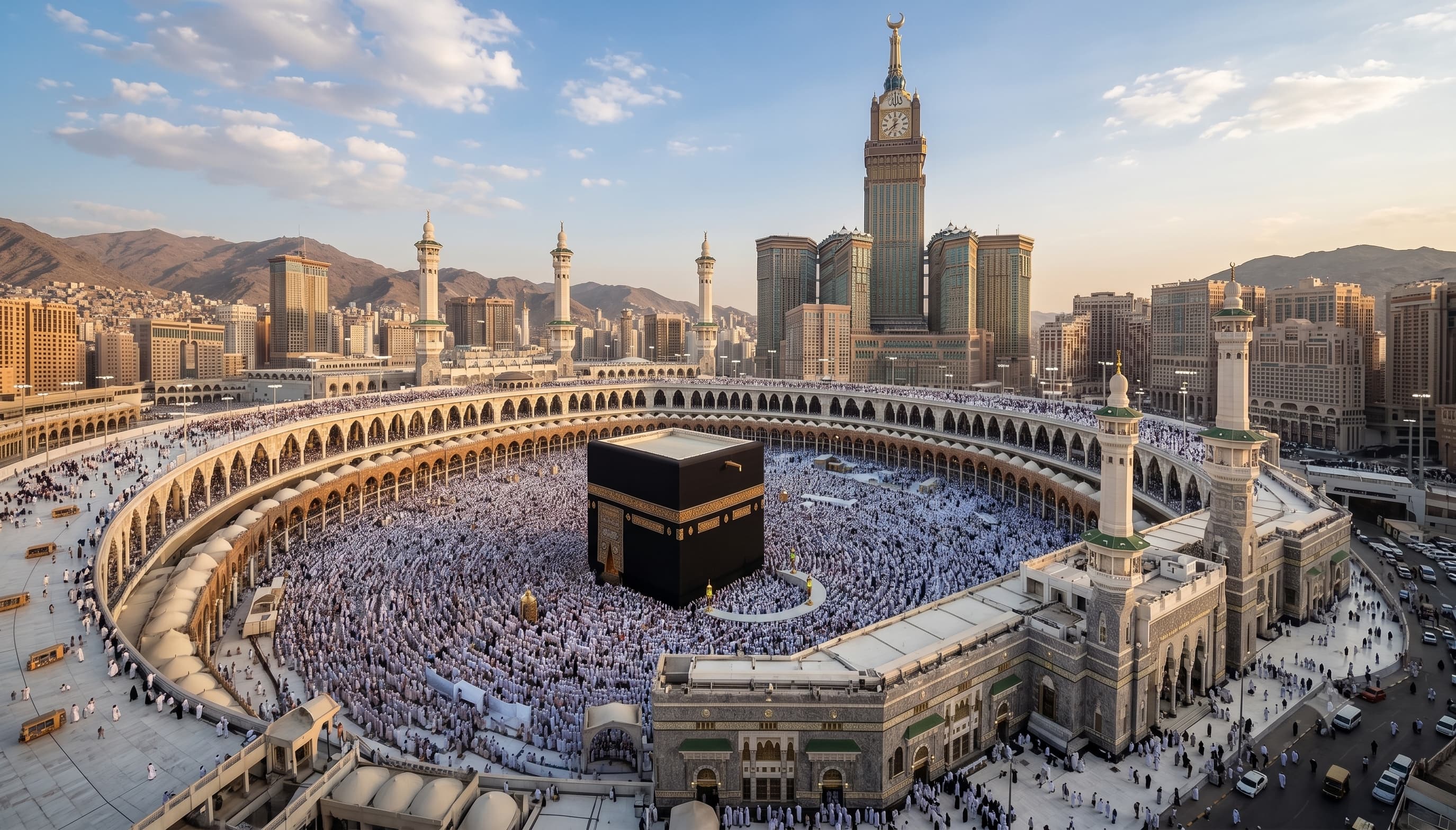
Tawaf is the circumambulation of the Ka'bah. You walk around it seven times, counterclockwise, with the Ka'bah on your left side at all times. Each circuit begins and ends at the Black Stone (Al-Hajar al-Aswad).
Before you begin:
You must be in a state of wudu. Tawaf is compared by the Prophet (ﷺ) to prayer, with the difference that speaking is permitted during it. (Narrated in Sunan at-Tirmidhi, and authenticated by the scholars.) If your wudu breaks during Tawaf, you leave, renew your wudu, and begin your circuits again from the start. You do not continue from where you left off, according to the strongest opinion among scholars.
At the Black Stone:
Begin by facing the Black Stone and raising your right hand toward it. If you are able to kiss it, do so. If not, and the crowds make it difficult, simply point to it and say:
Arabic: بِسْمِ اللَّهِ وَاللَّهُ أَكْبَرُ
Transliteration: Bismillah wa Allahu Akbar
Translation: "In the name of Allah, and Allah is the Greatest."
On subsequent circuits, say: Allahu Akbar as you pass the Black Stone. You say this once. Do not repeat it multiple times, and do not kiss your hand afterward, as this is not established from the Sunnah of the Prophet (ﷺ).
During Tawaf:
There are no specific duas prescribed for each individual circuit. Many booklets distributed to pilgrims contain a different dua for each round. Shaykh Ibn Uthaymin (may Allah have mercy on him) described these as an innovation not narrated from the Prophet (ﷺ). Use this time to make your own dua, recite Quran, or make dhikr as you wish.
The one exception is between the Yemeni Corner and the Black Stone, where the Sunnah is to say:
Arabic: رَبَّنَا آتِنَا فِي الدُّنْيَا حَسَنَةً وَفِي الْآخِرَةِ حَسَنَةً وَقِنَا عَذَابَ النَّارِ
Transliteration: Rabbana atina fi'd-dunya hasanah wa fi'l-akhirah hasanah wa qina 'adhab an-nar.
Translation: "Our Lord, give us that which is good in this world and that which is good in the Hereafter, and protect us from the torment of the Fire." (As narrated in Sunan Abi Dawud.)
Idtibaa' (for men):
Men uncover the right shoulder throughout the entire Tawaf. This is done by placing both ends of the Ridaa' over the left shoulder, leaving the right shoulder bare. This is called Idtibaa'.
Raml (for men):
In the first three circuits, men walk with short, quick steps, moving with a degree of haste. This is Sunnah and is not meant to involve running or pushing through the crowd.
Hijr Ismail:
An important point that many pilgrims miss. The Hijr Ismail, the semicircular wall adjacent to the Ka'bah, is considered part of the Ka'bah itself. You must walk around the outside of it, not through it. If you walk through the Hijr by entering one of its openings and exiting through the other, that circuit does not count.
After Tawaf:
Pray two rak'ahs behind Maqam Ibrahim. Allah (سبحانه وتعالى) says in the Quran: "And take the station of Ibrahim as a place of prayer." (Al-Baqarah: 125.) If it is too crowded directly behind Maqam Ibrahim, you may pray anywhere in the mosque. It is recommended to recite Surah Al-Kafirun in the first rak'ah and Surah Al-Ikhlas in the second. After this, it is Sunnah to drink from Zamzam water if it is accessible.
Common mistake: Thinking there is something special about touching Maqam Ibrahim itself, or seeking blessings from it. The only thing connected to Maqam Ibrahim is offering the two rak'ahs of prayer. Nothing has been authentically narrated regarding touching it or wiping over it.
Dua Between the Yemeni Corner & Black Stone
Step 3: Sa'i
Sa'i is walking between the two hills of Safa and Marwa seven times. It commemorates the actions of Hajar (may Allah be pleased with her), the wife of Ibrahim (عليه السلام), who ran between these hills in search of water for her infant son Ismail (عليه السلام). Allah (سبحانه وتعالى) says: "Verily, As-Safa and Al-Marwah are among the signs of Allah." (Al-Baqarah: 158.)
At Safa:
When you approach Safa, recite this verse once as you draw near, but do not repeat it after this point:
Recite the verse: "Inna as-Safa wa'l-Marwata min sha'a'irillah..." (Al-Baqarah: 158)
Then climb Safa, face the direction of the Ka'bah, raise your hands, and recite the following dhikr three times, making dua between each repetition:
Arabic:
لَا إِلَهَ إِلَّا اللَّهُ وَحْدَهُ لَا شَرِيكَ لَهُ، لَهُ الْمُلْكُ وَلَهُ الْحَمْدُ وَهُوَ عَلَى كُلِّ شَيْءٍ قَدِيرٌ، لَا إِلَهَ إِلَّا اللَّهُ وَحْدَهُ أَنْجَزَ وَعْدَهُ وَنَصَرَ عَبْدَهُ وَهَزَمَ الْأَحْزَابَ وَحْدَهُ
Transliteration: La ilaha ill-Allah wahdahu la sharika lah, lahu'l-mulk wa lahu'l-hamd wa huwa 'ala kulli shay'in qadir. La ilaha ill-Allah wahdahu anjaza wa'dah wa nasara 'abdah wa hazama al-ahzaba wahdah.
Translation: "There is no god but Allah Alone, with no partner. His is the dominion and to Him be all praise, and He is able to do all things. There is no god but Allah Alone. He fulfilled His promise, granted victory to His slave, and defeated the confederates Alone." (As narrated in Sahih Muslim.)
Say it once, then make dua. Say it a second time, then make dua. Say it a third time. Then proceed toward Marwa.
Walking between the hills:
One lap is from Safa to Marwa. The return from Marwa to Safa is the second lap. You begin at Safa and end at Marwa, completing seven laps total.
For men, it is Sunnah to walk quickly (not run) between the two green markers that you will see along the path. Outside of this section, walk at a normal pace.
When you reach Marwa, face the Ka'bah, raise your hands, and repeat the same dhikr and duas as you said at Safa. This is done every time you arrive at either hill.
Between the hills, outside the green markers, you may make any dua you wish, recite Quran, or make dhikr freely.
Common mistake: Raising your hands toward the Ka'bah while at Safa as if gesturing to it. Also, some pilgrims try to touch or seek blessings from the structure on the hill itself. None of this is from the Sunnah. Simply do what the Prophet (ﷺ) did: recite the dhikr, make dua, and move on.
Note: It is not Sunnah to pray two rak'ahs after completing Sa'i at Marwa. This is not authentically narrated from the Prophet (ﷺ).
Step 4: Halq or Taqsir (Cutting the Hair)
After completing Sa'i, the final step is to cut or shave the hair, which formally ends the state of ihram.
For men: Shaving the head completely (halq) is the preferred and more virtuous option. The Prophet (ﷺ) made dua three times for those who shave, and once for those who trim. (Narrated in Sahih al-Bukhari and Sahih Muslim.) However, trimming the hair (taqsir) is also valid. If you trim, it must be done from all over the head, not just from one section.
For women: A woman cuts approximately a fingertip's length from the ends of her hair. She does not shave her head.
Hair cutting can be done at the barbers located near the Mas'a (the Sa'i area), or for women, in the privacy of their hotel room.
Common mistake: Men trimming only a small amount, or cutting from one area of the head only. The trim must be taken from all over the head to be valid.
Step 5: Exiting Ihram
Once the hair has been cut or shaved, you have formally exited ihram. Everything that was prohibited during Ihram is now permitted again: wearing regular clothing, applying perfume, cutting nails, and marital relations.
Your Umrah is complete. May Allah accept it from you.
Madinah: Before or After Makkah?
Visiting Madinah is not a part of Umrah itself. It is not a ritual requirement, and your Umrah is valid regardless of whether you visit Madinah. However, most pilgrims choose to include it as part of their trip, and it is a tremendous blessing to visit the Masjid of the Prophet (ﷺ) and send salah upon him there.
Before Makkah: Many pilgrims, especially those traveling from outside the Arabian Peninsula, fly into Madinah first. This allows them to visit Masjid an-Nabawi, then travel to Makkah by road and enter ihram at Dhul Hulayfah (also known as Abyar Ali), which is the Miqat for those coming from Madinah. This is a common and well-organized route.
After Makkah: Others prefer to perform Umrah first in Makkah and then travel to Madinah before returning home. In this case, ihram is entered at the appropriate Miqat based on the direction of travel.
There is no religious preference for one order over the other. Both are valid. The choice often comes down to practical factors like flight routes, tour packages, and personal preference.
Practical Logistics
Best Time of Year
There is no wrong time to perform Umrah, but there are meaningful differences between seasons that are worth knowing before you book.
Ramadan is the most spiritually elevated time to perform Umrah. The Prophet (ﷺ) said that performing Umrah in Ramadan is equivalent in reward to performing Hajj with him. (Narrated in Sahih al-Bukhari and Sahih Muslim.) With that said, it is also the busiest time of year by far. The Mataf (the area around the Ka'bah) is shoulder-to-shoulder at almost any hour. Expect long waits and significant physical demand, especially in the last ten nights.
Dhul Hijjah (outside of Hajj days) is extremely busy due to the Hajj season. If you are not performing Hajj, it is generally better to avoid this month.
Muharram and Safar tend to be among the quieter months. The crowds are more manageable, temperatures are cooler depending on the year, and the overall experience is calmer.
Summer months bring intense heat. The marble of the Mataf and the outdoor areas can become very hot underfoot, particularly during midday. If you are traveling in summer, plan to perform Tawaf and Sa'i either early in the morning or later in the evening.
How Long Does Umrah Take?
The rituals of Umrah itself, from Tawaf through to the cutting of hair, typically take between two and four hours depending on crowd levels. In quieter periods, it can be completed faster. During Ramadan or peak times, it may take considerably longer just to complete Tawaf.
This does not include travel time to and from the Haram, waiting periods, or time spent in prayer and dua at the various sites. Most pilgrims find that even after completing the rituals, they want to stay and spend more time in the Haram.
What to Expect at the Haram
Masjid al-Haram is vast, and it can be disorienting the first time you enter. A few things to know:
- Bring a small bag to store your sandals when you enter. Many pilgrims lose their shoes because they leave them at the entrance without a way to identify them.
- Know which gate you entered through and note a landmark nearby. It is easy to exit through a different gate and become unsure of your surroundings.
- Security staff are stationed throughout the Haram and are generally helpful if you need guidance.
- Wheelchairs are available for those who need them, but be aware that wheelchair users move through the crowd and you may find one crossing your path during Tawaf.
- Keep your valuables secure. The Haram is a safe environment, but it is also an extremely crowded one.
Choosing a Umrah Company
For most pilgrims traveling from outside Saudi Arabia, Umrah is booked through a licensed umrah company. The quality of the experience, from accommodation to guidance on the ground, varies significantly between companies.
A few brief things to look for: a company that is licensed by the relevant authority in your country, clear pricing with no hidden costs, accommodation within a reasonable distance of the Haram, and knowledgeable guides who can answer questions about the rituals.
Written from firsthand experience. All ritual guidance is drawn from established Islamic scholarship and sources.