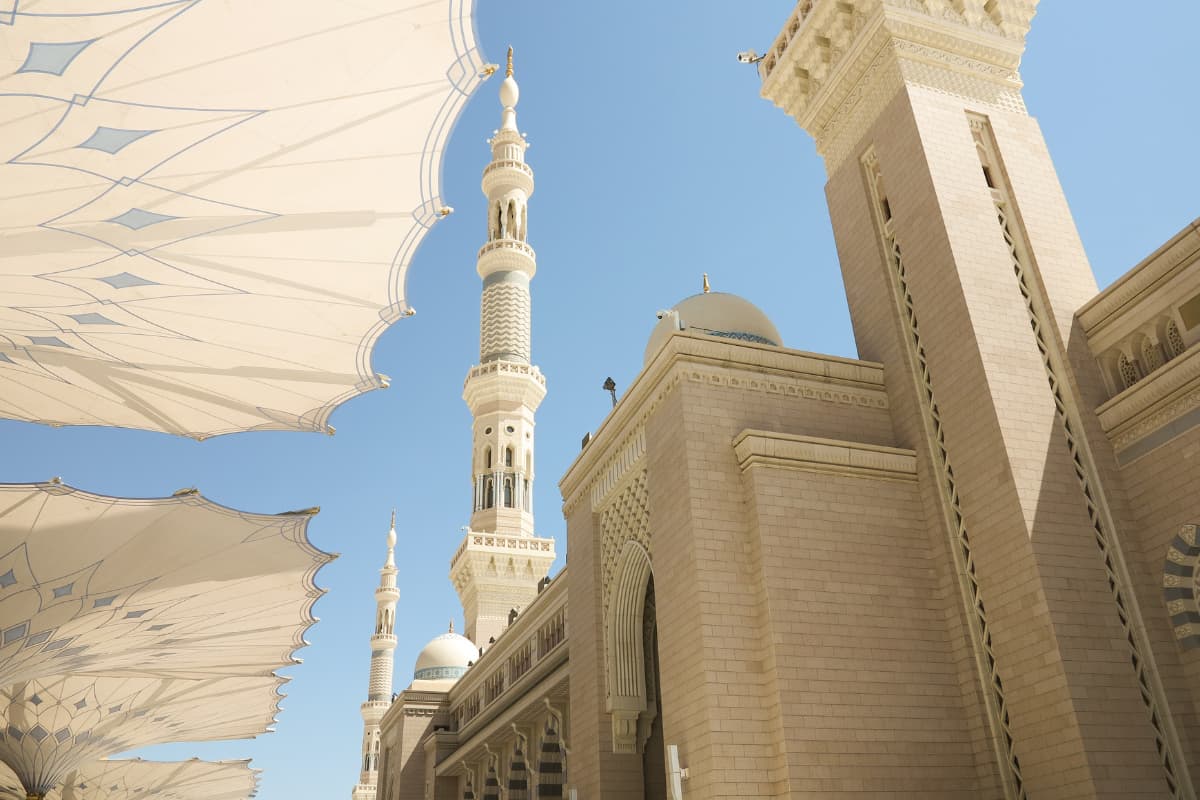
Madinah is the second holiest city in Islam and the burial place of the Prophet (ﷺ). Most pilgrims visit as part of their Umrah trip. This guide covers the key sites, the best times to visit, and the practical details worth knowing before you arrive.
Madinah holds a place unlike any other city on earth. It is where the Prophet (ﷺ) emigrated, where he lived, and where he is buried. Visiting it is not a part of Umrah, and your pilgrimage is valid whether you come or not. But very few pilgrims who have the means to visit choose to skip it.
The Virtues of Visiting Madinah
The Prophet (ﷺ) said: "Whoever visits me after my death, it is as if he visited me during my life." (Narrated by al-Daraqutni and others.) He also said that a single prayer in Masjid an-Nabawi is equivalent to a thousand prayers elsewhere, except at Masjid al-Haram. (Narrated in Sahih al-Bukhari and Sahih Muslim.)
Visiting Madinah is Sunnah, not obligatory. But the reward attached to it is significant, and the scholars are in agreement that whoever is able to visit should do so.
A Common Mistake: What Visiting the Prophet (ﷺ) Actually Means
This is worth addressing directly, because it is the most serious error pilgrims make in Madinah.
Visiting the Prophet (ﷺ) means going to his masjid, praying there, and sending salah and salam upon him at his grave. It does not mean making dua to him, asking him to intercede directly, or directing any form of worship toward him. Doing so crosses into shirk, which is the gravest sin in Islam.
The correct practice, as established by the Sunnah, is to stand at the grave and say:
Arabic: السَّلَامُ عَلَيْكَ يَا رَسُولَ اللَّهِ
Transliteration: As-salamu 'alayka ya Rasulallah
Translation: "Peace be upon you, O Messenger of Allah."
You then move on. The dua you make should be directed to Allah alone, not through or to the Prophet (ﷺ).
Some pilgrims, caught up in emotion, make supplications at the grave that amount to asking the Prophet (ﷺ) for help. This is not from the Sunnah and is explicitly warned against by the scholars. Go to Madinah with love for the Prophet (ﷺ) -- and express that love through following his Sunnah, not through actions he never taught.
When to Visit
Madinah is far more manageable outside of peak periods. The city receives a high volume of pilgrims during:
- Ramadan: the busiest period by a significant margin
- Dhul Hijjah: Hajj season draws massive crowds
- Thanksgiving and winter break: Western Muslim families travel in large numbers during these school holidays
- Summer: particularly July and August, which fall during school holidays in many countries
Outside of these windows, Muharram through Sha'ban tends to be quieter. The courtyards are less crowded, the hotels are more affordable, and the overall experience is calmer.
For time of day within Madinah, the best times to visit Masjid an-Nabawi and the surrounding sites are after Isha and between Fajr and Dhuhr. Midday, particularly in summer, is the most congested and the heat can be significant.
Getting Around
Uber and Jeeny both operate throughout Madinah and are generally more convenient and cheaper than the local taxis. Both apps work reliably across the city and to the surrounding sites.
Madinah Prince Mohammed Bin Abdulaziz Airport is 20 to 30 minutes from the city centre by car, depending on traffic.
The Ziyarah Sites
Beyond Masjid an-Nabawi, Madinah has a number of sites that carry historical and religious significance. The following are the most important for pilgrims to visit. Individual guides for each site are being added to the site.
Masjid Quba
Masjid Quba holds the distinction of being the first masjid built in Islam. The Prophet (ﷺ) said that praying two rak'ahs there carries the reward of an Umrah. (Narrated in Sunan Ibn Majah and authenticated by the scholars.) It is a short drive from Masjid an-Nabawi and easy to include in a single morning.
Masjid al-Qiblatain
This is the masjid where the qibla changed from Jerusalem to Makkah during the Prophet's (ﷺ) lifetime. The Prophet (ﷺ) was mid-prayer when the revelation came, and he turned to face the new direction without breaking his prayer. The congregation followed. It is one of the more historically striking sites in the city.
Uhud
The site of the Battle of Uhud, where the Prophet (ﷺ) was wounded and seventy companions were martyred, including his uncle Hamzah (may Allah be pleased with him). Visiting the martyrs and sending salah upon them is established from the Sunnah. The Prophet (ﷺ) visited Uhud himself and encouraged others to do so. This is one of the more moving sites in Madinah, particularly for those who know the story of the battle.
Sab'ah Masajid
A cluster of small masajid on the site where the trench was dug during the Battle of the Trench (Ghazwat al-Khandaq). The masajid are built over spots where the Prophet (ﷺ) and various companions prayed during the siege. Historically significant and often overlooked by pilgrims who run out of time.
A Note on What to Skip
Not every site promoted to pilgrims in Madinah carries legitimate religious basis. Some locations have become associated with practices -- touching structures, seeking blessings from specific spots, visiting graves with particular supplications -- that are not established from the Sunnah and that the scholars have warned against.
The general principle is straightforward: do what the Prophet (ﷺ) did, and avoid what he did not do. Visiting the key sites listed above, praying in the masajid, and spending time in Masjid an-Nabawi is a full and rewarding itinerary. You do not need to seek out every landmark on a tour group's list.
Written from firsthand experience living in Madinah. All religious guidance is drawn from established Islamic scholarship.